
BREAKING: Canada Is Refusing Trump's Demand For Unlimited Access To Uranium/Nuclear Fuel To Power The Broligarchy
The Trump Regime quietly tried to strong arm Canada, to power the Broligarch's AI dream of unlimited energy and freedom cities. Mark Carney jus keeps saying "No."

If you’ve seen a deepfake about Carney rebuffing Rump’s demand for uranium, it’s true. Mostly. Not the deepfake. That’s bullshit. However, what IS true is Canada’s Prime Minister has refused Trump’s demand for “unlimited access” to explore Canada’s undiscovered MASSIVE lithium and uranium deposits. Several times. Most recently, last week.
It happens the way consequential moments usually do now: off-camera, through intermediaries, inside rooms where the people involved understood exactly what was at stake.
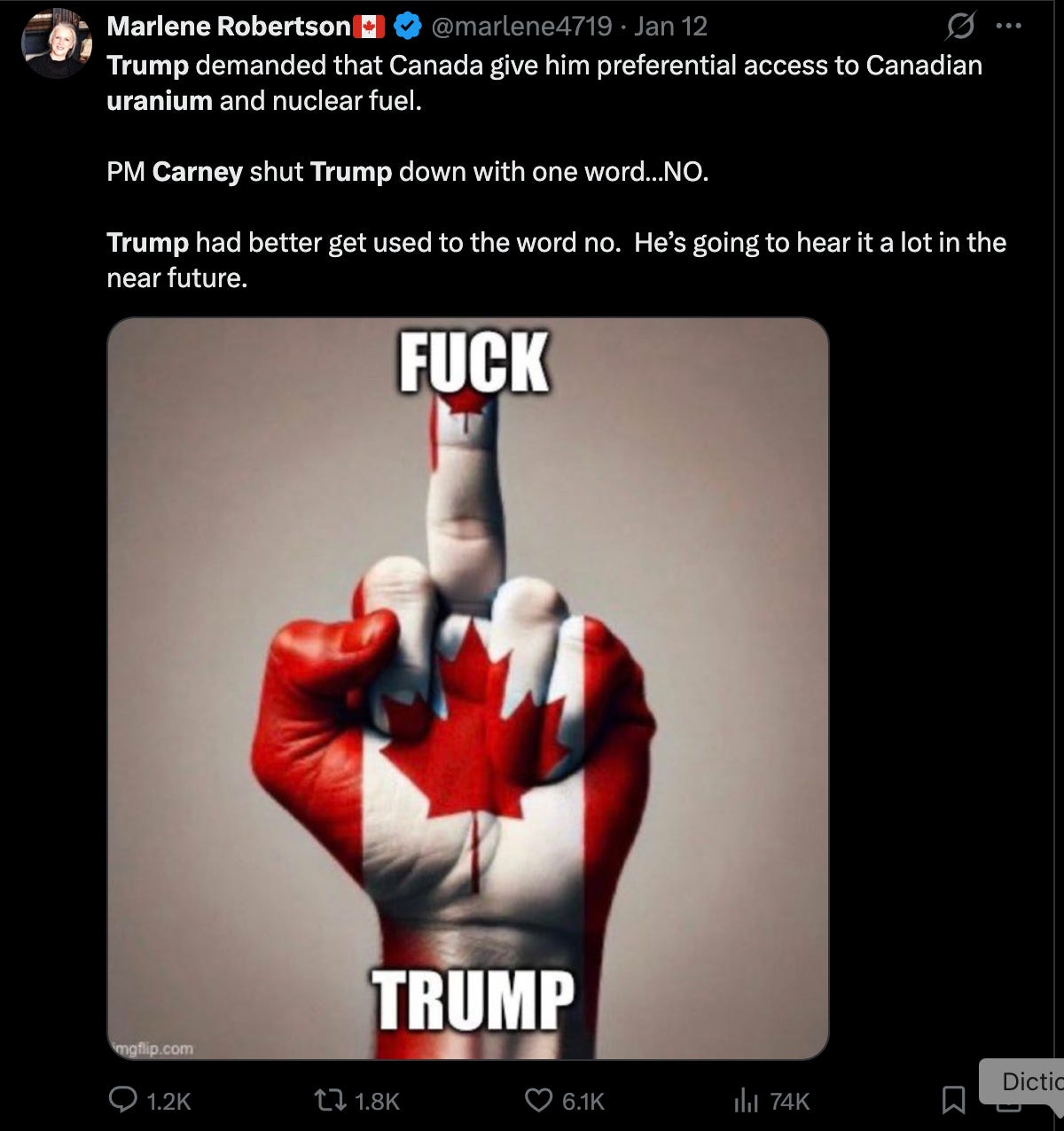
Donald Trump wanted something from Canada. Unlimited access to Canada’s natural resources (rare earth, energy, and specifically, uranium)."
Mark Carney refused. Four times, according to sources.
And THAT is the quiet log jam and one of the reasons Trump said he plans on destroying Canada’s automotive industry, yesterday in Detroit.
For a presidency built on the belief that pressure always works, it was an embarrassment. He doesn’t want you to know that Mark Carney and Canada aren’t rolling over.
The Part They Didn’t Say Out Loud
Trump’s second-term economic fantasy rests on a single, inconvenient reality: America’s artificial intelligence ambitions are devouring energy faster than the country can produce it. The data centers powering generative AI, military automation, logistics systems, and surveillance infrastructure don’t scale politely. They spike demand, relentlessly and without pause.
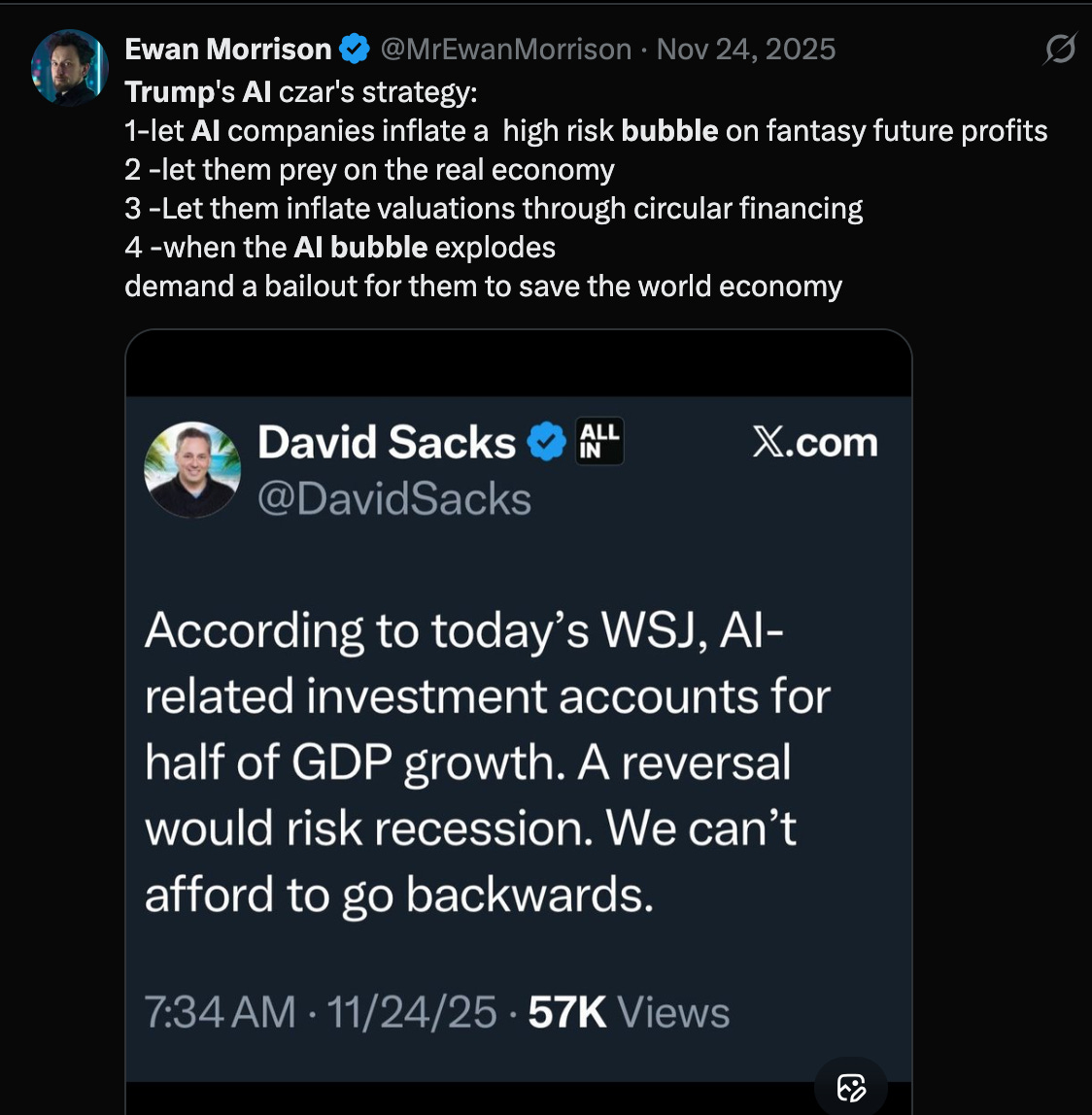
In fact, Wall Street is being held together by 11 AI/Tech companies right now. AKA, the “Trump AI Bubble.” If the bubble bursts due to a lack of fuel/energy, that bubble bursts.
Silicon Valley’s answer—championed loudly by the same tech executives now whispering in Trump’s ear—is nuclear. Not decades from now. Now. Hundreds of small modular reactors are needed to power always-on compute systems that never sleep and never slow down.
It’s a moonshot, pitched as innovation. But it comes with a problem Washington can’t brute-force away.
The United States does not control the nuclear fuel/rare earth ecosystem needed to make that vision a reality. And the United States does not have the capacity, natural resources to power America’s “AI future” as designed by the Broligarchs and desired by the Trump Regime
Canada does.
So does Europe.
And suddenly, what had been framed as “cooperation” started to sound a lot like expectation. Preferential access. Political assurances. Accelerated approvals. Quiet commitments about where Canadian uranium would—and would not—be sold.
The subtext was obvious: help us build this, or we’ll find a way to make it your problem.
When “National Security” Becomes a Tell
This is the same rhetorical pivot Trump made when he set his sights on Greenland. The language always follows the same arc. First comes the “strategic interest.” Then the warnings. Then the suggestion—sometimes joking, sometimes not—that sovereignty is negotiable when American security is invoked loudly enough.
Greenland was the rehearsal. Canada will be the test that matters.
Because threatening Denmark is one thing. Pressuring Canada is something else entirely.
Canada isn’t just another ally. It’s structural. Intelligence sharing. Arctic defense. NATO credibility. Five Eyes trust. The quiet assumption, shared across Europe, that whatever else happens, Ottawa remains steady.
Trump was told—clearly—that crossing that line wouldn’t produce leverage. It would detonate what remains of the alliance system he’s already strained to the breaking point.
That’s why the pressure never went public. And that’s why the refusal mattered so much.
Carney Didn’t Push Back. He Declined.
Mark Carney treated the demand the way professionals treat requests that don’t meet the standard: he rejected it and moved on.
There will be no rearrangement of Canada’s regulatory framework to serve America’s AI ambitions to please the five richest men in the world and their rapist felon President while he calls Canada his “Vassal State.”
And that, more than anything, is what Trump wasn’t prepared for.
The Moment the Leverage Flipped
Trump’s worldview depends on escalation. On the idea that if you push hard enough, eventually someone yields. What Canada demonstrated instead was something far more destabilizing to that model: refusal without fear.
There was no urgency in Ottawa’s response. No anxiety about retaliation. No scramble to soften the edges. Just a recognition that Canada’s position was stronger than Washington wanted to admit—and that acting like it was normal diplomacy wasn’t defiance. It was realism.
That kind of calm is contagious.
A Quiet Blueprint for the Rest of the World
Canada didn’t insult Trump (even though I wish we would). It didn’t humiliate him. It didn’t trigger a crisis. It showed something subtler and more useful: how to deny an unreasonable demand without setting fire to everything around it. Not embarrassing Trump publicly has been top of mind for Carney, and I can’t imagine the restraint it must take.
That matters, because a growing number of U.S. allies are facing similar pressures—economic, strategic, political—and wondering how to respond without becoming the next target.
Canada just gave them an answer. '“NO.”
Ego Doesn’t Power Reactors
Artificial intelligence doesn’t care who’s president. Nuclear reactors don’t respond to threats. Supply chains don’t bend because someone declares urgency on social media.
Trump assumed that wanting something badly enough—and calling it national security—would make it inevitable. Canada reminded him that sovereignty still exists, and that leverage doesn’t always belong to the loudest voice in the room.
Sometimes it belongs to the country that can afford to say no—and mean it.
Canada answered without raising its voice.
It exposed the limits of Trump’s approach—not with confrontation, but with clarity. Something Canada/Carney has been brilliant at doing, according to world-renowned economist Justin Wolfers.
He’s going to hear that word again.
From Europe. From Asia. From countries that have quietly realized they don’t have to play along.
Not because they’re anti-American.
But because they’ve learned the difference between leadership and entitlement—and Canada just showed them what it looks like.
Imagine if Trump behaved like a real president, more like Mark Carney and less like an entitled brat. How much better the United States could be right now.
Once again, having to leave a bunch of ❤️ emojis for PM Carney, who does a masterful job of denying T. —- That our Congress should be doing, but simply cannot! Thanks, Dean, for letting us know what’s happening (and of course another ❤️ for you!)