

August 17, 2026
Sometime between his morning rage-posts on Sunday, Donald Trump hit send on the most accidentally honest thing he's ever published: an AI-generated video of himself giving George Washington a guided tour of his imaginary $400 million ballroom — the one federal courts just told him he can't build — complete with the caption "Thank you, George, for some of your brilliant ideas on this great Military Complex/Ballroom!"
And because the delusion has a costume department, the AI shrunk Washington — a granite slab of a man who stood 6'3" in an era when that made you a giant — down to Trump's height and gave him Trump's body, waddling through the chandeliers like a colonial cosplayer at a Mar-a-Lago buffet. This is projection in its purest laboratory form: a man who has never once told himself no, digitally kidnapping the man whose entire legend is built on refusal — refused a crown, refused a palace, refused a third term, refused power itself — and forcing his corpse to nod approvingly at the gilded throne room he's suing the country to build. Trump thinks he was flattering himself by standing next to Washington. He was actually volunteering for the most brutal side-by-side in American history. So let's give him one.
George Washington had one book of philosophy that we know he actually owned and read: a 1702 translation of Seneca’s Morals. He wasn’t a scholar. Unlike Jefferson and Adams, he never got the fancy classical education. What he got instead, as psychotherapist Donald J. Robertson lays out in his essay on Washington’s Stoicism, was a teenage apprenticeship in character — long visits to the Fairfax family estate at Belvoir, where a household of devout Christians who devoured Plutarch and Marcus Aurelius taught a lanky Virginia kid that the only empire worth ruling is the one between your own ears.
Historian Eliot Morison put it this way in 1932: the chapter headings of that Seneca book alone were “the moral axioms that Washington followed through life.”
Hold that thought. Because in less than 80 days, Americans are going to vote on whether any of those axioms still apply — or whether the country Washington built now belongs to a man who represents the precise, molecular, oil-and-water opposite of everything Washington was.
Let’s do this properly. Specific examples. Hard comparisons. Receipts.
The Temper
Start with the thing nobody tells you about Washington: he wasn’t naturally calm. He was a furnace. Thomas Jefferson said Washington’s temper was “naturally irritable” and that when it broke loose, he was “most tremendous in his wrath.” Gilbert Stuart, who painted him and studied his face for hours, said that if Washington had been born in the forests, he would have been “the fiercest man among the savage tribes.”
That’s the whole point. Washington’s composure wasn’t a personality trait. It was a construction project. A lifetime of deliberate, grinding self-discipline, started at fourteen when he hand-copied 110 Rules of Civility into a notebook and spent the next fifty years living them. The man contemporaries marveled at — the granite calm at Valley Forge, the silence under vicious newspaper attacks, the stillness in rooms full of panicking men — was a volcano that decided, every single day, not to erupt. People who met him described the effect as almost physical. Abigail Adams, no pushover, quoted poetry trying to capture his presence. Foreign officers wrote home that they’d never seen a man command a room by saying less.
Now the comparison. Donald Trump’s temper isn’t a furnace he contains. It’s the product. It’s the brand. The 2 a.m. all-caps posts. Calling a decorated prisoner of war a loser to his face — “I like people who weren’t captured,” about John McCain, a man who refused early release from a torture camp. Attacking a Gold Star family. Mocking a disabled reporter’s arms on camera. Nicknames for judges, generals, senators, war widows. Aides across two administrations describing screaming fits over cable news coverage. Washington spent fifty years building a dam. Trump monetized the flood.
Cato, and What Washington Did at Valley Forge
Washington’s favorite piece of writing on Earth was Joseph Addison’s play Cato — the story of Cato the Younger, the Roman Stoic senator who chose death over submission to Julius Caesar’s tyranny. Washington quoted it in his letters for decades. He referenced it in correspondence with Sally Fairfax. Patrick Henry’s “give me liberty or give me death” and Nathan Hale’s “I only regret that I have but one life to give” are both echoes of lines from that play.
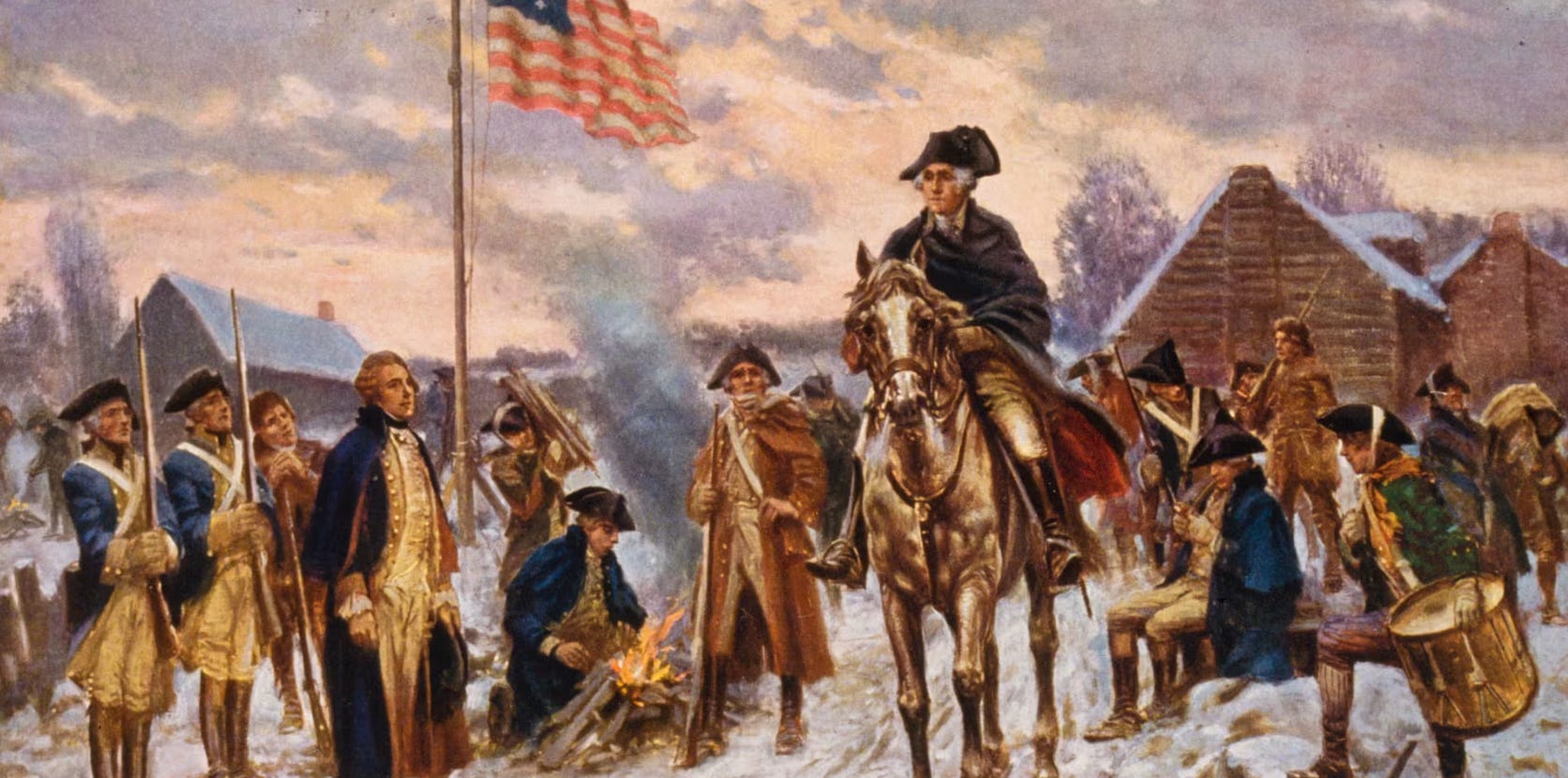
And in the spring of 1778, at Valley Forge — with his army starving, freezing, barefoot, and dissolving around him — Washington had Cato performed for his officers. Think about that. His response to the darkest moment of the Revolution wasn’t a rage session about who betrayed him. It was staging a play about a man who valued the republic over his own life, so his officers would remember what they were freezing for.
Trump’s favorite cultural references are himself. His response to adversity is the enemies list. When he faced his darkest political moment — losing the 2020 election by seven million votes — he didn’t reach for Cato. He reached for the phone, called Georgia’s secretary of state, and asked him to “find 11,780 votes.”
Cato died rather than let one man become Rome. Trump posted, in 2025, “He who saves his Country does not violate any Law” — a line attributed to Napoleon. Washington’s hero was the man who resisted Caesar. Trump’s is Caesar.
Newburgh: The Day One Man Stopped a Coup With a Pair of Glasses
March 1783. The war is essentially won, and the Continental Army is furious — Congress hasn’t paid them, and an anonymous letter is circulating among the officers proposing they march on the government and take what they’re owed by force. This is the moment. Every revolution in history curdles right here. The army, the guns, the grievance, the beloved general. All Washington had to do was nod.
Instead he walked into that meeting hall at Newburgh uninvited, gave a speech that wasn’t landing — and then stopped, pulled a pair of spectacles from his pocket that almost none of his officers had ever seen him wear, and said: “Gentlemen, you will permit me to put on my spectacles, for I have not only grown gray, but almost blind, in the service of my country.
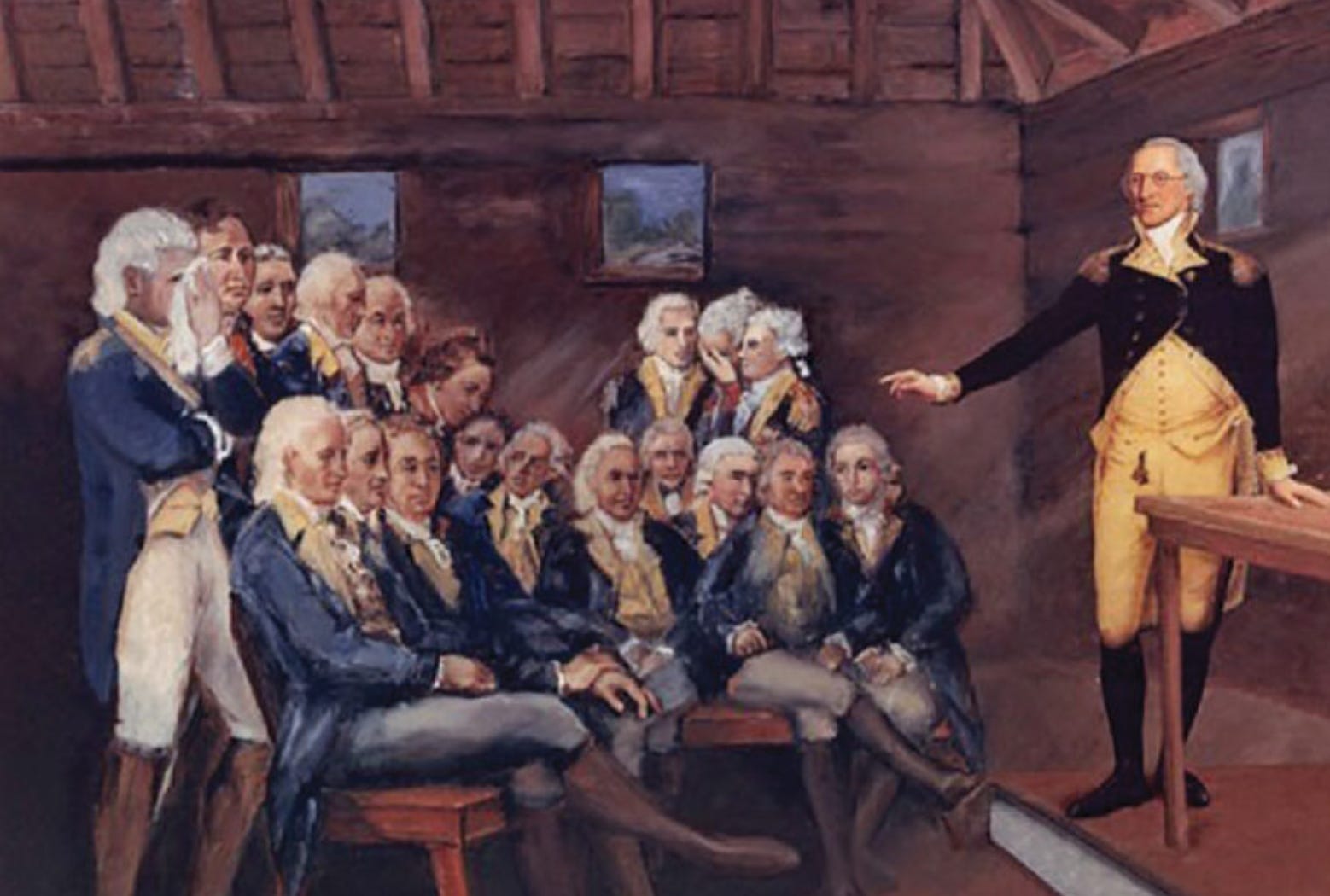
Grown men wept. The coup died in that room. Not from force. From character. From the accumulated moral weight of a man who had asked nothing for himself for eight years.
A year earlier, when Colonel Lewis Nicola wrote suggesting Washington become king, Washington fired back that no occurrence in the entire war had given him more painful sensations, and ordered Nicola to banish the thought from his mind.
Compare and weep: January 6, 2021. A president who lost an election, watching on television as a mob he summoned, told to “fight like hell,” ransacked the Capitol hunting his own vice president — and doing nothing for 187 minutes while aides begged him to call it off. Washington was handed a coup on a silver platter by men who loved him, and he shamed them out of it with a pair of reading glasses. Trump manufactured one out of thin air because his feelings were hurt.
The Resignation That Broke a King’s Brain
December 23, 1783. Washington rides to Annapolis, stands before Congress, and hands back his commission as commander-in-chief. Voluntarily. At the absolute apex of his power and popularity, when he could have had anything — a crown, a title, a permanent army at his back — he bowed to a civilian government that had barely paid his troops, and went home to farm.
When King George III heard Washington might actually do this, he reportedly told the painter Benjamin West that if Washington gave up power, “he will be the greatest man in the world.” The king literally could not compute it. In the entire history of monarchy, generals did not do this. Caesar didn’t. Cromwell didn’t. Napoleon didn’t. Washington did it twice — because thirteen years later, after two terms as president, with re-election guaranteed for life if he wanted it, he walked away again, establishing the two-term tradition that held for 150 years on nothing but the force of his example.
Trump: refused to concede an election he lost. Skipped the inauguration like a child. Spent four years calling the transfer of power a steal. And now, back in office, muses openly about a third term while his store sells “Trump 2028” hats and his allies float “methods” around the 22nd Amendment — the amendment that only exists because lesser men eventually stopped honoring Washington’s example. Washington gave up power twice when no law required it. Trump won’t respect the limit even when the law demands it.
The Palace Problem
When Washington took office, the Senate spent weeks debating what to call him. Vice President John Adams pushed for “His Highness the President of the United States and Protector of Their Liberties.” Others floated “His High Mightiness.” Washington wanted none of it. The republic settled on the most aggressively boring title imaginable — “Mr. President” — precisely because Washington understood that in America, the office was supposed to be bigger than the man, and the man was supposed to be a citizen, not a sovereign.
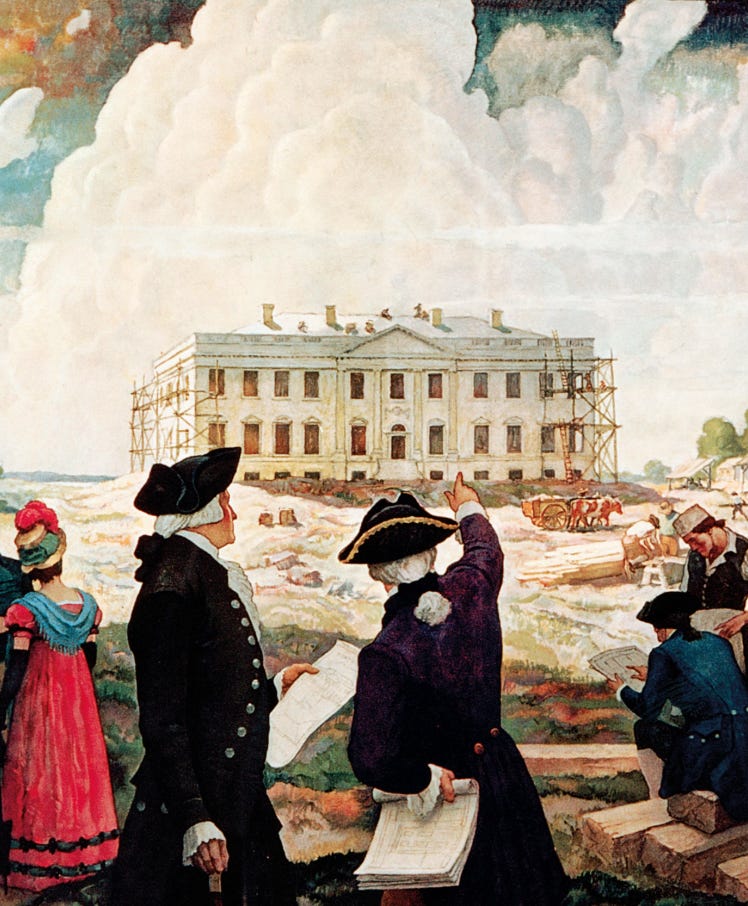
Same story with the residence. Pierre L’Enfant’s original vision for the executive mansion was a genuine European-style palace, roughly four times the size of what got built. Washington — who personally oversaw the project and never even got to live in it — insisted on something more modest, a house befitting an elected magistrate of a republic, not a throne room. He turned down a presidential salary until Congress insisted he take one. He was surrounded, his entire public life, by men who wanted the baubles — the titles, the pomp, the hereditary honors, the glitter of European courts — and he shunned every last piece of it, because he understood something they didn’t: the moment the presidency looks like a crown, the republic is already dying.
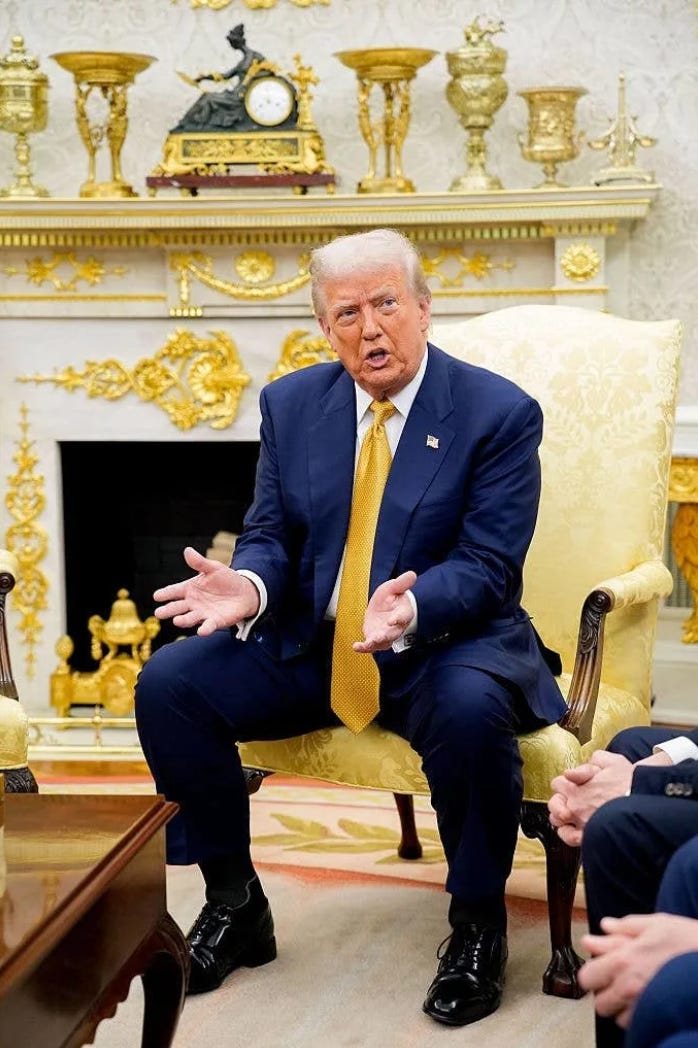
Now look at what’s happened to that house. Gold trim slathered across the Oval Office. The Rose Garden paved over into a patio. And in October 2025, the East Wing of the White House — the actual, physical People’s House — demolished to make way for a gilded 90,000-square-foot ballroom, funded by corporate donors with business before the government, its renderings looking like Versailles got a Mar-a-Lago membership. Add the multimillion-dollar military parade rolling tanks through Washington on the president’s birthday — the exact kind of Caesar-cosplay Washington built the entire office to prevent. Washington rejected a palace he was offered. Trump is building one nobody asked for, with the People’s House as the demolition site
Values, Line by Line
Washington’s Farewell Address in 1796 — his parting gift, drafted with Hamilton — reads today like a prophecy written by a man who met Donald Trump in a fever dream. He warned against “cunning, ambitious, and unprincipled men” who would use party passion to “subvert the power of the people” and seize “the reins of government.” He warned that the spirit of faction “opens the door to foreign influence and corruption.” He warned that demagogues would ride public rage to power and then “usurp for themselves.” He begged the country to guard its institutions against the man he could see coming.
Put the ledgers side by side. Washington: took no pay he didn’t have to, and left office poorer in energy and health than he entered. Trump: a family crypto empire, a meme coin launched days before inauguration, foreign-funded golf deals, a $400 million jet from Qatar. Washington: demanded his officers swear loyalty to the Constitution. Trump: reportedly asked his FBI director for loyalty to him, and asked why his generals couldn’t be more like Hitler’s. Washington: absorbed brutal press attacks in silence because he believed a free press, however vicious, was the price of a republic. Trump: “the enemyy of the people,” lawsuits against networks, threats to pull licenses. Washington: told the Hebrew Congregation of Newport that the American government “gives to bigotry no sanction, to persecution no assistance.” Trump: built a movement on the sanction and perfected the assistance.
Even Washington’s honesty about his own flaws shames the comparison. He owned human beings — the great, unforgivable stain — and he knew it, wrestling with it privately for decades and becoming the only major founder to free his enslaved workers in his will. It doesn’t absolve him. But it shows a man capable of moral self-examination, a category of activity Trump has never once been observed performing. Washington’s last act was an attempt at conscience. Trump’s every act is an attempt at applause.
“But That Was a Different Era”
The defense, such as it is: Washington never faced cable news and social media. Voters are exhausted by scripted politicians and read Trump’s rage as authenticity. His combativeness is strategy, not weakness. And the founders were flawed men we shouldn’t sanctify.
Fine. All partially true. And all completely beside the point — because the Stoics answered this 2,000 years ago. The crowd’s applause is what Seneca called an “external.” It means nothing. The only question that ever matters is whether you govern your passions or your passions govern you. Washington faced mutinies, starvation, betrayal by allies, and newspapers accusing him of wanting to be king, and he governed himself through all of it. Trump faces a mean segment on television and loses a night’s sleep to the phone. That’s not a different era. That’s a different species of man.
The Choice
Here’s the thing about Washington that King George couldn’t understand and Trump never will: power was never the prize. Character was the prize. Washington spent his whole life building a self worth handing power to — and that’s exactly why he could hand it back. The republic was founded on the gamble that Americans would keep choosing men like that, or at least men who aspired to be.
In less than 80 days, that gamble gets tested again. This isn’t a normal midterm. It’s a referendum on which inheritance you want: the country founded by a man who tamed his own temper, staged Cato for his starving troops, talked his officers out of a coup with a pair of spectacles, refused a crown, refused a palace, refused a third term, and rode home to his farm while a king muttered in disbelief — or the country remade in the image of a man who has never once, in eighty years on this Earth, told himself no.
Washington’s values built the republic. A mad king’s values are how republics end. The Stoics said your character is your fate.
In 80 days, it’s also America’s.
Riffing off Donald J. Robertson’s “The Stoicism of George Washington” (Medium), Eliot Morison’s The Young Man Washington*, and about 240 years of receipts.*
You are by far my favorite substack writer - I rarely miss reading one of your articles. Today you've outdone even yourself. Thanks, Dean!
The Father of our Country... versus the Mother of all Motherf**kers.... Seems like a fair comparison....