
Why Does Everyone Hate AIPAC? I'll Explain...
A Nazi-era law, a 1962 switcheroo, a hundred million dollars in shell-game money, and a war-criming Israeli PM. Here’s the explainer they don’t want you to read

I want to start with a date.
November 21, 1962.
That is the day Attorney General Robert F. Kennedy’s Department of Justice formally ordered the American Zionist Council — the lead lobbying arm for the State of Israel in the United States — to register as a foreign agent. Not as a suggestion. Not as a friendly nudge. As a legal order, under the Foreign Agents Registration Act of 1938, the same law Franklin Roosevelt signed to flush out Nazi propaganda networks operating on American soil.
Six weeks later, an AZC employee named Isaiah L. Kenen quietly incorporated a new organization a few blocks away in Washington, D.C. He gave it a different name. He gave it a different tax structure. He gave it — and this is the part that matters — a different legal theory of what it was. Not a foreign agent. No, no. A purely American organization, comprised of American citizens, who happened to enthusiastically support a foreign country. Different thing entirely.
He called it the American Israel Public Affairs Committee.
You may know it by its initials.
AIPAC.
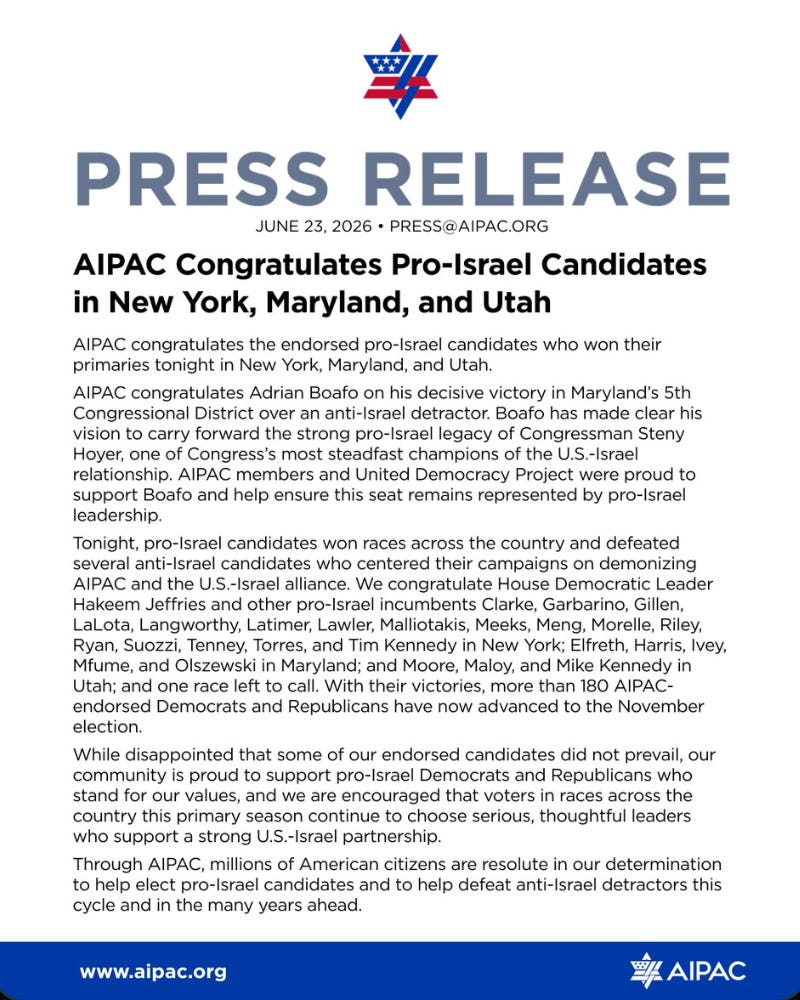
I’m telling you this story first because every single thing you’re about to read — every PAC, every primary, every threatened senator, every gilded resort retreat, every Democratic congressman with his career ended by an ad campaign about a subway sandwich — descends from that one piece of legal sleight of hand in early 1963. AIPAC was not founded as a normal advocacy group that happened to grow controversial. AIPAC was founded specifically to evade a federal disclosure law that its predecessor had been caught violating. That is its origin. It is in the DNA. It is the load-bearing wall.
And for sixty-three years, every administration — Republican, Democrat, doesn’t matter — has politely declined to revisit Kenen’s clever little workaround. Not Reagan. Not Bush. Not Clinton. Not Obama. Not Trump 1. Not Biden. Nobody.
Until now.

Now the wall is starting to crack. And it’s cracking because of something so brutal, so televised, so undeniable, that even the lobby’s own donors are flinching. We’ll get there. First, you need to understand what the operation is.
What AIPAC actually does
Strip away the brochures and the gala dinners and the bipartisan-friendship language, and AIPAC does exactly three things.
One: it lobbies Congress to send Israel money. A lot of money. $160 billion since 1949. About $3.8 billion a year now, baseline, plus emergency supplementals. After October 7, 2023, AIPAC pushed through a $14.1 billion emergency aid package — a number that, by no coincidence whatsoever, matched the figure publicly demanded by Israeli Prime Minister Benjamin Netanyahu down to the last dollar.
Two: it lobbies Congress to vote however Israel’s government wants on every adjacent issue. Iran sanctions. Iran nuclear deal — AIPAC reportedly spent $30 million trying to kill that one in 2015. Anti-BDS laws. ICC sanctions. UN resolutions. You name a vote that affects Israel’s freedom of action, AIPAC has a position, and the position is whatever Likud’s position is that week.
Three — and this is the part that’s gotten everyone’s attention lately — it spends staggering amounts of money to destroy the political careers of any American politician who refuses to vote the way it wants.
I’ll repeat that, because the word “lobby” softens it past the point of usefulness. AIPAC does not just advocate. AIPAC openly and publicly takes out American elected officials who don’t sufficiently support a foreign government. It is the single most aggressive primary-spending operation in American politics, and it spent over $100 million on the 2024 election cycle alone.
For one issue. One.
The NRA wishes. Big Pharma wishes. Big Oil wishes. Nobody else operates at this scale on a single foreign policy issue. Nobody.
The Bowman job
Let me make this concrete, because I think people glaze over at the dollar figures and miss the cruelty of how it works.
In the summer of 2024, AIPAC decided to end the career of Congressman Jamaal Bowman of New York’s 16th Congressional District. Bowman is a former middle-school principal. He’s Black. He’s a Democrat. His sin: he had called what Israel was doing in Gaza by a name AIPAC did not want it called. He had used the word “genocide.”
AIPAC’s super PAC, the United Democracy Project, dropped $14.6 million into one Democratic primary in one congressional district in suburban New York. Pro-Israel groups combined spent $28.3 million to take Bowman’s seat. To put that in perspective: that is more outside money than has ever been spent against a single House member in a primary in American history. It shattered the previous record. By a country mile.
The ads barely mentioned Israel. They never do. The ads went after Bowman on rent control and student debt votes and a fire alarm he’d pulled in the Capitol. They aired his face next to Donald Trump’s, somehow, to a Democratic primary electorate. They quoted Elie Wiesel’s son accusing him of “lies and conspiracy theories” — meaning, in plain English, that Bowman had told the truth about Israel.
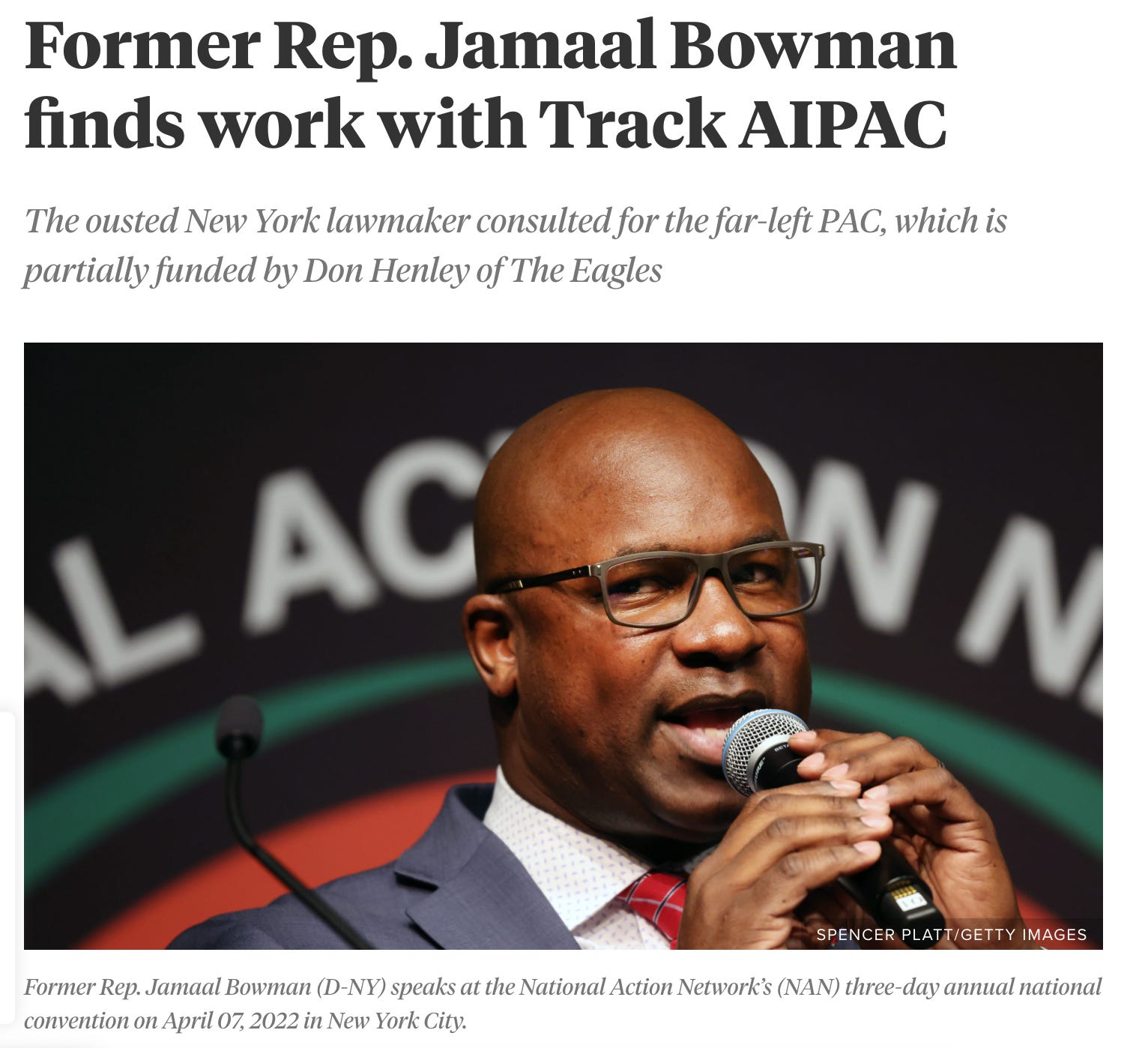
Bowman lost. By a lot. Now he runs the TRACK AIPAC cite that Laura loomer wants banned, because of course she does.
And the message — to every single other member of Congress watching at home — was crystal clear. This is what happens to you. Even if you’re popular. Even if you’re a good legislator. Even if your district loves you. We can spend more on your primary than your entire campaign will spend in two cycles combined. We can drown you in a swimming pool of money over a single word. So shut your mouth, vote how we tell you, or you’re next.
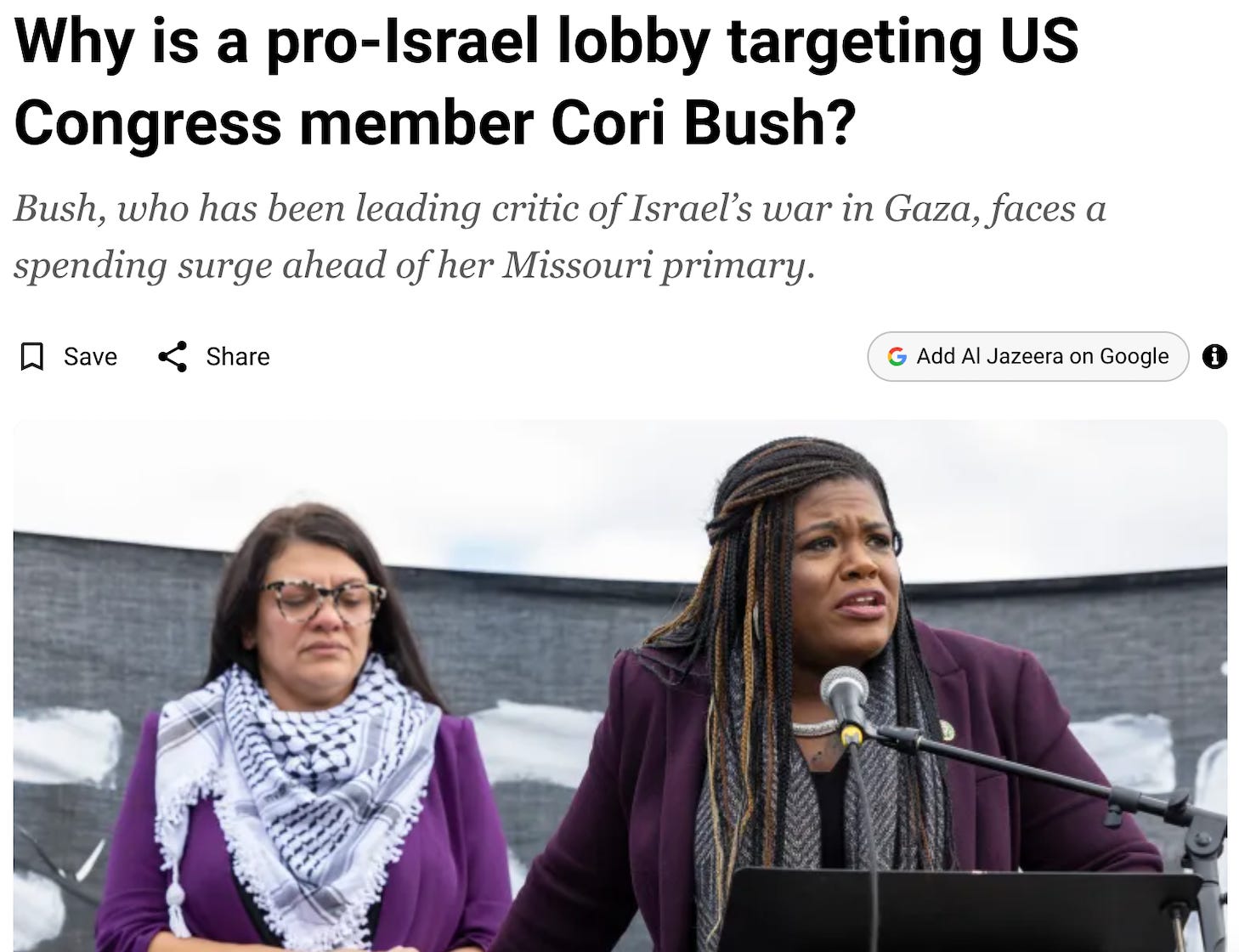
It worked. Cori Bush — also Black, also a Democrat, also a critic of Israel’s conduct in Gaza — got the same treatment a month later. $8.5 million against her. She got flyers that allegedly darkened her skin color in the images. Summer Lee survived hers. Ilhan Omar survived hers. Rashida Tlaib was deemed too dangerous to challenge openly. But the chilling effect went everywhere. Ask any Democratic House staffer what their boss is allowed to say publicly about Israel right now, then watch their eyes
The legal magic trick
So how is any of this legal?
I’m so glad you asked. Pour a drink.
After Citizens United in 2010 — the Supreme Court ruling that effectively deleted meaningful limits on outside political spending — AIPAC discovered that the old shoe-leather lobbying model was for chumps. Why bother trying to persuade a congressman when you can just replace him? In December 2021, the organization formed its own conventional PAC. A few months later it launched the United Democracy Project, a super PAC that, at launch, didn’t even mention Israel in its “About Us” page. Cute.
This is the structure now. Three entities. AIPAC, the 501(c)(4) lobbying nonprofit. AIPAC PAC, the conventional political action committee. United Democracy Project, the super PAC that can accept unlimited contributions from billionaires. Money sloshes around between the three of them in ways that make it nearly impossible to trace any individual donation to its original source, which is precisely the design.
And — pay attention here — none of this is required to register under FARA. None of it. Because of that one trick Kenen pulled in 1963. AIPAC’s official position is that it does not take money from the Israeli government, does not have Israeli government officials on its board, and does not formally act “at the direction” of the Israeli government. Therefore, technically, in the narrow language of the statute, it is not a foreign agent.
It is just a domestic group, funded by Americans, that:
has offices in Jerusalem
coordinates messaging directly with the Office of the Prime Minister of Israel
briefed Congress on Israel’s Gaza military operation using Israeli military talking points
spent $30 million opposing the Iran deal in exact lockstep with Netanyahu’s personal lobbying campaign on the same issue
pushed an emergency aid package matching Netanyahu’s demand to the dollar
delivered ICC sanctions on the schedule Foreign Minister Israel Katz publicly requested
and routes more privately funded congressional trips to one foreign country than any other lobby in Washington routes to the rest of the world combined
But not a foreign agent. Of course not. Don’t be ridiculous.
If a Russian organization with even half this profile existed, every single person in Washington would know its name, and that name would be followed by the phrase registered foreign agent. We know this because that’s how it works for literally every other country. Turkey’s lobbying operation — tiny by comparison — has resulted in multiple FARA registrations. Saudi lobbying runs through registered agents. China’s CGTN had to register. Russia’s organizations got prosecuted aggressively after 2016.
AIPAC alone — the largest, richest, most politically active foreign-interest lobbying operation in the United States — is exempt. Because Isaiah Kenen had a really good lawyer in 1962.
“Concerned American citizens”
I want to address the most common defense, because it deserves an honest answer.
The defense goes: AIPAC represents American citizens who care about Israel. It’s no different from the Cuban-American lobby or the Armenian-American lobby or AARP. It’s grassroots. It’s democratic. The members are Americans. Their money is American. Their votes are American.
This is the line Kenen invented, and it is the line AIPAC has used in court and in Congress for sixty years. And in the narrowest possible legal reading, it is technically true.
Here is the problem.
A former AIPAC employee — M.J. Rosenberg, who worked there directly under Kenen in the 1970s and again in the 1980s — has gone on record in The Forward saying, in plain English, that Kenen told him exactly why he set the organization up the way he did. Not as a sincere grassroots vehicle. As a legal workaround. “He told me that he came up with the AIPAC formula,” Rosenberg wrote, “so that AIPAC would be legally permitted to engage in politics and not have to reveal its activities.”
Quote unquote. From the man’s own colleague. From inside the room.
Then add the leaked documents. The Guardian and other outlets have reported on internal Israeli Ministry of Justice memos from 2018-2022, in which Israeli officials sought legal advice on how to avoid FARA disclosure requirements by — and I am not making this up — setting up American nonprofits that would be “informally managed by the Israeli government.” That is what the memo says. In writing. From a foreign ministry. About how to do exactly what AIPAC is alleged to do.
You know what we call it when a foreign government deliberately structures a U.S. organization to evade federal disclosure law and run political operations on its behalf? In any other context — Russian, Chinese, Iranian, Saudi — we call it a foreign influence operation. We pass laws about it. We hold hearings about it. We prosecute it.
In this one specific context, we call it AIPAC’s “About Us” page.
The revolving door
I want to give you one more number, because it speaks louder than any rhetoric.
Sixty-six.
That is the number of former AIPAC staffers currently working inside the United States government — across Congress, the White House, and various branches of the military — as of a 2026 analysis by the human rights group DAWN. Sixty-six. From a single lobby. Reverse the metaphor: that’s not a revolving door, that’s a passenger ferry.
These are not random low-level analysts. These are foreign policy directors, legislative assistants, defense advisors, congressional chiefs of staff. They write the bills. They draft the memos. They brief the senators. They are the people who decide what the United States government thinks about Israel, and they were trained by AIPAC, paid by AIPAC, and shipped into government with their professional networks built at AIPAC.
If sixty-six former employees of any other single-issue advocacy group were embedded throughout the federal government, you would have read about it. You would have heard about it on cable news. There would be a congressional hearing about it. It would be a scandal.
There is no hearing. There is no scandal. There is just the operation, humming along, doing what it was built to do.
Subscribe
What changed: Gaza
Now we get to your question. The big one. The one that motivated this whole piece.
Why is everyone hating AIPAC right now, when this operation has been running the same way for six decades?
The answer has one word in it, and the word is Gaza.
For sixty years, AIPAC’s protection racket worked because of a simple bargain: Americans were broadly sympathetic to Israel, mostly didn’t follow the foreign policy details, and accepted the lobby’s framing of any criticism of Israel as antisemitism. The system was watertight. Politicians who toed the line got money. Politicians who didn’t got primaried. Reporters who pressed the issue got smeared. The general public never saw enough of the underlying conflict to challenge the framing, and the gatekeepers — major newspapers, network news, both political parties — were thoroughly trained to keep it that way.
Then October 7, 2023 happened. And then the next two and a half years happened.
I do not need to describe what the world has watched on its phones since then. You’ve seen it. You’ve seen the children. You’ve seen the journalists killed at numbers that exceed every other modern conflict combined. You’ve seen the famine engineered by deliberate aid blockade. You’ve seen the universities flattened, the hospitals stormed, the southern “safe zones” bombed, the displaced families bombed in the displaced zones they were told to flee to. You’ve seen ICJ rulings, ICC arrest warrants, UN reports, Amnesty International reports, Human Rights Watch reports, Israeli historians using the word genocide. You’ve seen Netanyahu standing next to Donald Trump grinning about a “Riviera of the Middle East” on the rubble of Gaza City while children die of starvation a hundred yards away.
And — this is the part AIPAC didn’t plan for — you’ve watched the United States Congress, your Congress, the one your tax dollars fund, vote yes to every single weapons shipment. Every single emergency package. Every single UN veto. Every. Single. One.
Watching what we have watched, and watching our own elected officials sign the checks for it, has done something to American public opinion that AIPAC’s hundred-million-dollar war chest cannot undo. The bargain has broken. The framing has collapsed. The smear-anyone-who-criticizes-Israel playbook has run out of dirt to throw. You cannot call Bernie Sanders, the descendant of Holocaust victims, an antisemite. You cannot call Pope Francis, the late literal Pope, an antisemite. You cannot call Amnesty International, the ICC, the ICJ, and the entire population of every campus in North America antisemites — well, they’re trying, but it isn’t landing anymore.
The curtain came down. The thing that was always there is suddenly visible. And once you’ve seen it, you can’t unsee it.
The Track AIPAC effect
In April 2024, two former Democratic campaign staffers — Cory Archibald and Casey Kennedy — launched an anonymous Twitter account called Track AIPAC. Their idea was beautifully simple, and Washington had no defense against it.
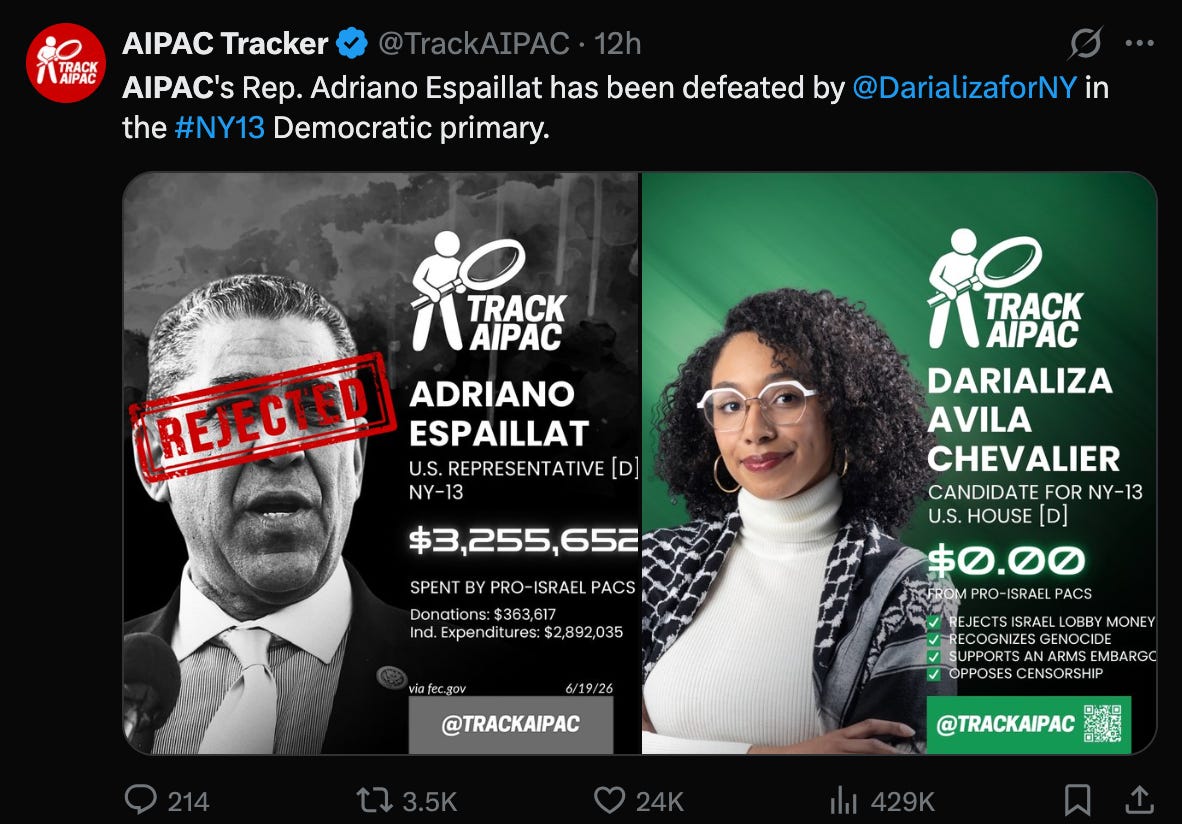
They just posted the receipts.
FEC filings. Public records. Cross-referenced. Color-coded. Red cards for politicians taking AIPAC money. Green cards for politicians refusing it. Every cycle, every dollar, every congressman, every senator, in a format that fit on a phone screen and could be reshared in under three seconds.
Within a year, that account — and the broader project it spawned, including the FEC-registered super PAC literally called Citizens Against AIPAC Corruption — had done something nobody had ever managed to do before: it made AIPAC money toxic.
Politicians who had quietly cashed AIPAC checks for years suddenly couldn’t, because their constituents could see the donation in real time. Centrist Democrats started returning checks. Returning them. Voluntarily. The Forward‘s Jacob Kornbluh has fretted that Track AIPAC’s graphics are “misleading”; Krystal Ball credits the account with turning AIPAC into “a lightning rod in American politics.” Both of them are describing the same earthquake.
By 2026, AIPAC was so wounded by its own visibility that it started — and this is reported by Al Jazeera and confirmed in FEC filings — routing money through shell PACs to disguise its origin. The most powerful lobby in Washington, the one that has eaten its lunch for sixty years, has been reduced to hiding behind front groups so its name doesn’t appear on the ad. That is what defeat looks like at this stage of the game.
What’s next
Here is what is happening, right now, in 2026, and what is almost certainly happening next:
More Democrats refusing AIPAC money every month. Pramila Jayapal, the Squad obviously, but increasingly centrists too — anyone whose constituents are paying attention.
Bipartisan FARA reform bills floating in Congress, including provisions that would close the Kenen loophole and force AIPAC to register or restructure. They will not pass under this Congress. They are getting closer to passing every cycle.
A growing list of countries — most of the developed world, at this point — that have publicly broken with the U.S. position on Israel, leaving American politicians who parrot AIPAC’s line increasingly out of step not just with their own voters but with the entire Western alliance.
Public polling on Israel that has collapsed among Democrats and slid noticeably even among Republicans under 35. The bipartisan consensus that was AIPAC’s whole product is gone.
And the looming question — when does the Department of Justice finally revisit 1962? — gets louder every news cycle. The right answer is probably “when the politics make it survivable for whoever sits in the AG’s chair.” The politics are getting there. They weren’t a year ago. They are now.
The thing nobody wants to say
I’ll close with the hardest part.
Criticizing AIPAC is not criticizing Jewish people. It is not criticizing Judaism. It is not criticizing Israel’s right to exist, or American Jews’ right to advocate for Israel, or anybody’s right to lobby their own government on any issue under the sun. AIPAC is an organization. A lobbying operation. A political machine. A money pipeline. It has Jewish leaders and Christian Zionist allies and a board of directors and an org chart and a tax structure and a war chest. It is not a synonym for Jews. It is not even a synonym for the State of Israel. It is one extremely powerful Washington influence operation, and like every other extremely powerful Washington influence operation, it can be examined, criticized, investigated, and — if necessary — regulated.
Conflating those two things is the single oldest move in AIPAC’s playbook, and it is the move that is failing in real time. Because the Jewish voices speaking loudest against what is happening in Gaza right now — J Street, Jewish Voice for Peace, IfNotNow, T’ruah, the Israeli historians and journalists who use the word genocide because they are watching it happen on their own television sets — those people cannot be smeared as antisemites. The smear has broken on contact with reality.
It simply doesn’t work anymore.
What you are watching, my friends, is a sixty-three-year-old protection racket meeting an event so monstrous that no amount of money, no amount of advertising, no amount of primary-spending, and no amount of bullying can quite paper over it anymore. AIPAC is not hated because it advocates for Israel. AIPAC is hated because it has, for two and a half years, demanded that the American government finance and arm what most of the planet call war crimes — and has bought, threatened, and primaried into silence every American politician who tried to say no.
That’s it. That’s the whole story.
And once you can see it — once Kenen’s clever little 1962 trick stops being invisible — there is nothing AIPAC can do to put the curtain back up.
Sooner than you think.
Sources: Federal Election Commission filings on AIPAC PAC and United Democracy Project; OpenSecrets outside-spending data for the 2024 cycle; Al Jazeera’s May 2026 reporting on AIPAC’s use of shell PACs and DAWN’s analysis of 66 former AIPAC staffers in federal government; New York Times coverage of Democratic lawmakers declining AIPAC donations; M.J. Rosenberg’s 2018 essay in The Forward on Kenen’s “legal loophole”; Grant F. Smith and IRmep’s 2009 and 2018 FARA filings on AIPAC’s relationship to the dissolved American Zionist Council; the November 1962 DOJ order to the AZC under Attorney General Robert F. Kennedy; the 2005-2009 United States v. Franklin, Rosen, and Weissman case (E.D. Va.); Barack Obama’s 2020 memoir A Promised Land on AIPAC’s congressional influence; J Street’s polling on American Jewish opinion vs. AIPAC’s lobbying positions; the Track AIPAC project (Cory Archibald and Casey Kennedy, April 2024) and the Citizens Against AIPAC Corruption super PAC (FEC ID C00879080, May 2024); reporting from The Guardian on leaked Israeli Ministry of Justice memos (2018-2022) regarding FARA-avoidance strategies; Amnesty International, Human Rights Watch, ICJ, and ICC findings on Gaza 2023-2026; and reporting from JTA, The Forward, Mondoweiss, Jewish Currents, and Haaretz on the post-October 7 collapse of AIPAC’s bipartisan consensus.
I think this was the most eye-opening post I’ve read in the last two years on Substack. I never have supported or donated to any lobbying groups like this one or the DNC, RNC, or any of the others that I can’t identify specifically. Sounds like that was a pretty good decision on my part. Hope that after the November elections, we can get the bipartisan FARA passed and get rid of things like AIPAC. Thank you, Dean, for spelling this out with such clarity.
Thanks for this post Dean. This is why I am a proud paid subscriber - I learn so much with your posts!